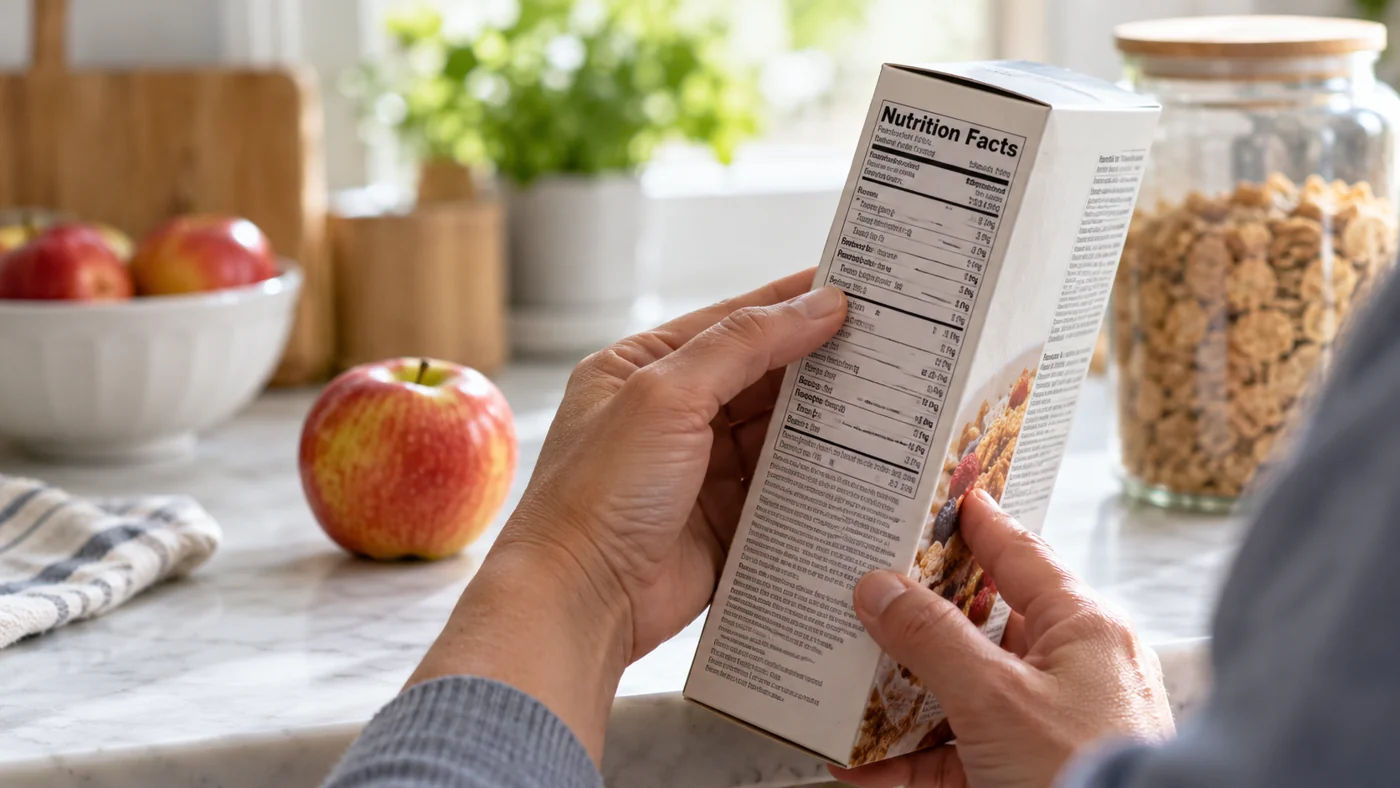
A Nutrition Facts label is easiest to use when you start with serving size, then compare the nutrients that matter to your decision. The numbers generally describe one listed serving, which may differ from the portion you eat. FDA’s general guide calls 5% Daily Value or less low and 20% or more high for an individual nutrient. Those percentages do not rate the whole food.
Reviewed October 25, 2026. U.S. reader guide. Rules and services can change; use the official sources linked below for the latest requirements.
Table of Contents
Nutrition Facts label: start with the serving
The serving size is a measurement reference. FDA explains that it reflects an amount people typically eat or drink, rather than a recommendation for how much a particular person should have. The package also tells you how many servings it contains.
Before comparing two products, check whether their stated servings match. A small-looking number can reflect a smaller serving rather than a meaningful difference in the food. Keep the familiar unit and the metric quantity together when comparing.
Imagine two hypothetical snack packages. One lists 160 calories for 30 grams; the other lists 200 for 40 grams. Comparing only 160 with 200 ignores the different quantities. The useful question is what amount you intend to compare or eat, rather than which package has the smallest headline number.
2. Work out the portion you actually use
When you eat two listed servings, the corresponding nutrient quantities generally double. If a hypothetical soup lists 400 milligrams of sodium per serving and you eat two servings, the portion provides 800 milligrams. This is arithmetic applied to an example, not a recommendation for a particular person’s diet.
A package may contain more than one serving even when it looks like a convenient single snack. Read servings per container before assuming the whole package matches the calorie number printed near the top.
Some labels provide two columns to help show a serving and the entire package. Read the column heading each time. Switching between columns midway through a comparison can produce an answer that looks precise but combines different amounts.
3. Use percent Daily Value for one nutrient at a time
The percent Daily Value, or %DV, places a nutrient amount in the context of a daily reference. FDA’s 5% and 20% guide helps distinguish relatively low and high amounts per serving. A nutrient can be low while another on the same label is high.
The percentages are not meant to be added vertically into one product score. A 10% entry for one nutrient and 15% for another do not mean the food supplies 25% of everything a person needs. Each row refers to its own reference.
Consider a hypothetical item with 4% DV of one nutrient and 22% DV of another. The correct description preserves both facts. Calling the entire product low or high without naming the nutrient would discard the information the label provides.
4. Separate total sugars from added sugars
FDA explains that total sugars includes naturally occurring and added sugars. The added-sugars amount is included within the total, rather than an extra amount to add a second time. This is why the word includes on the label matters.
If an invented yogurt example lists 12 grams of total sugars and includes 5 grams of added sugars, the total remains 12 grams. It is not 17 grams. That calculation answers a label-reading question without deciding whether the product fits someone’s medical or nutritional needs.
Total sugars does not carry the same %DV treatment as added sugars. A blank percentage should not be interpreted as zero grams. Read the quantity and the row name together instead of assuming every nutrient uses exactly the same format.
5. Compare like quantities and relevant rows
Choose the question you want the comparison to answer. You might be comparing sodium in two soups or fiber in two cereals. Check the same nutrient, the serving quantity and any relevant column on each label. Keep those three items consistent.
An ingredient list answers a different question from a nutrient panel. A marketing phrase on the front of the package also has a different role. Neither should be used as a shortcut that makes the actual serving and nutrient numbers disappear.
For a practical shopping note, write the product name, serving amount and the two or three rows you are comparing. You do not need to copy the entire panel to avoid switching units. A photograph can also help if it is clear enough to read the headings.
6. Keep general references separate from individual advice
The label uses a 2,000-calorie reference for general nutrition advice. FDA notes that individual calorie needs vary. A reference printed on a package is therefore not a personal prescription or a complete eating plan.
People managing a health condition, a food allergy or a prescribed diet may need additional information beyond this general reading guide. The useful role of the label is to supply quantities that can be discussed with a qualified professional, rather than to replace individualized care.
For future shopping, repeat the check when a package changes. Serving sizes, recipes and formats can be updated. A note saved from a previous purchase should not automatically override the panel on the current product.
The habit to build is consistent reading: find the serving, match the portion, identify the nutrient and check the unit. That sequence makes the information more usable without turning a single number into a judgment about an entire food or a person’s diet.
Frequently asked questions
Is the serving size a recommendation?
No. FDA says it reflects the amount people typically consume. It is not a personalized recommendation of how much to eat or drink.
What do 5% and 20% Daily Value mean?
As a general FDA guide, 5% DV or less is low and 20% DV or more is high for an individual nutrient per serving.
Should I add added sugars to total sugars?
No. Added sugars are included within total sugars. Adding them again would count that amount twice.
Does a blank %DV mean the nutrient is absent?
No. Some nutrients do not have a %DV in the same way. Check the listed quantity and FDA’s explanation of that row.
Read more from Health. To suggest a factual correction, contact USRPTV and include the source and date.