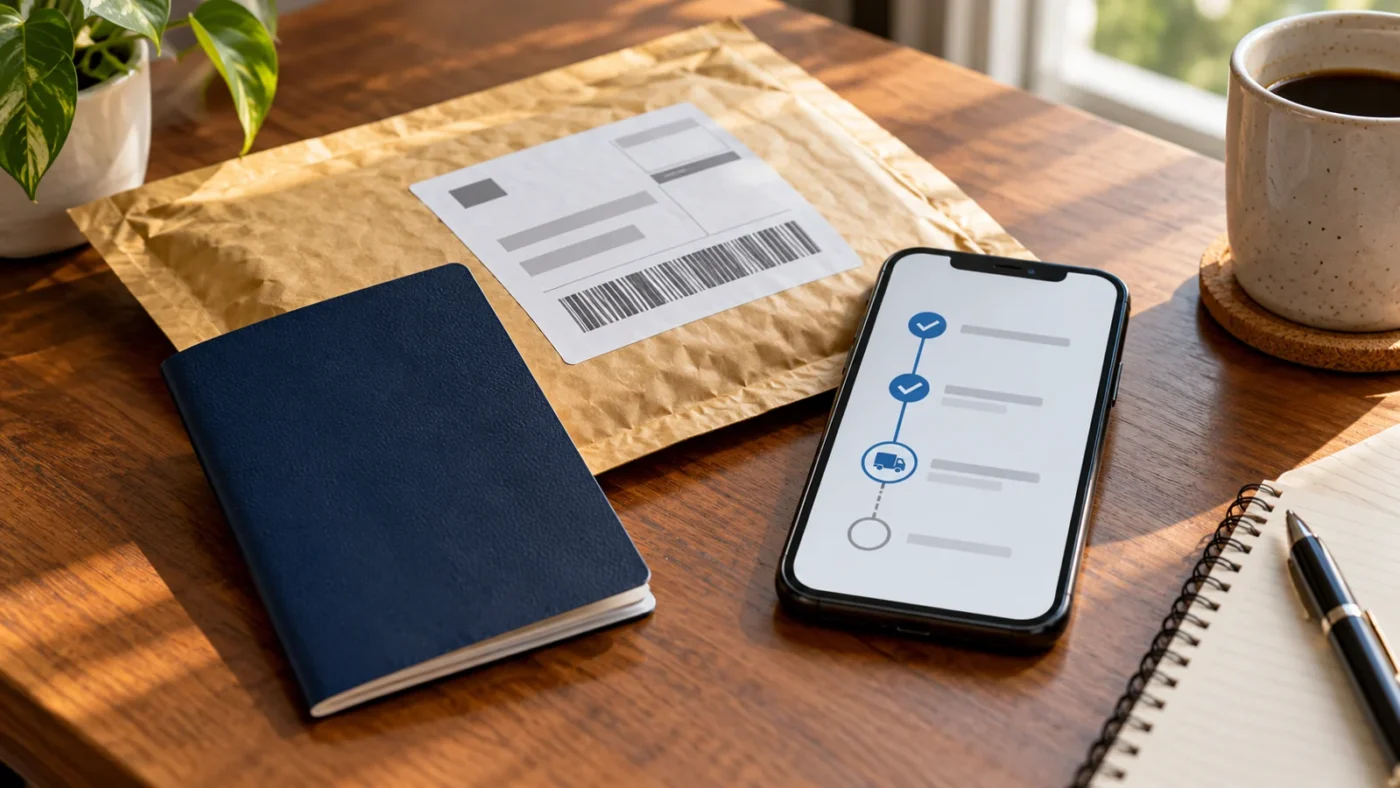
If your mailed passport application says delivered but the application status is not available, delivery tracking and State Department intake may be showing different stages. The Department explains that a delivery scan at a mail facility does not necessarily mean the application has already been received at a passport agency or entered into its status system.
Start by confirming the tracking number, the application method and the exact details used in the official status checker. Do not assume that a blank status means your application was rejected, that the documents are lost or that you should send a second application immediately.
This guide follows the State Department’s application-status guidance. Processing times and urgent-travel procedures can change. Use the current official instructions for your circumstances rather than an old estimate copied into a social-media answer.
Separate the stages before interpreting a scan
A mailed application passes through several distinct events. The carrier transports an envelope. A receiving facility handles the delivery. The application then enters the passport-processing workflow. Later, a status record may describe review, approval or shipment. One event does not automatically confirm that every later event has occurred.
Read the wording on the tracking page carefully. A package delivered to the designated mail facility is evidence about the envelope’s postal journey. It is not a decision on citizenship documents, photo acceptability, fees or passport issuance.
Likewise, a passport application appearing in the status system does not mean the finished passport is already in the mail. Keep the sequence clear so that each record answers the question it is designed to answer.
| Record | What it tells you | What it does not establish |
|---|---|---|
| Outbound carrier tracking. | Movement and delivery scan for the mailed package. | Completion of passport-agency intake. |
| Application-status record. | The status available in the passport system. | That every original document has returned. |
| Passport return tracking. | Shipment information for the finished passport, when provided. | That supporting documents are in the same envelope. |
| Supporting-document delivery. | Return of original materials sent with the application. | A new decision about a separate family member’s application. |
Confirm whether you applied by mail, in person or online
The correct status route depends on the application method. A mailed renewal, an application accepted in person and an online renewal do not all use identical intake and status steps. Follow the official instructions for the method you actually used.
If you applied at an acceptance facility, distinguish the date of your appointment from later mailing and processing events. The facility accepting paperwork is not the same event as a passport agency beginning its work. Keep any receipt supplied at the appointment.
If you renewed online, use the online-renewal status guidance rather than trying to explain the case through a mailed application’s tracking sequence. An email about an online submission and a postal delivery scan are different records.
Check the information entered in the status tool
Use the genuine government status page and follow its formatting instructions. Enter the applicant’s information as required, paying attention to the surname, suffix or hyphenated name instructions. A small mismatch can prevent a useful result.
For a family applying together, check each person separately with the correct details. Sharing an outbound envelope or travel date does not make the applications a single record. One person’s visible status does not prove the others have reached the same stage.
Do not send a public screenshot of a status form containing a birth date, Social Security information or full identifying details. If you need help with an error message, describe the message without exposing the personal values entered.
Build a simple application timeline
- Record the date and method of application.
- Save the mailing or acceptance receipt.
- Record the carrier’s delivery scan and location description.
- Note the date you checked the official application status.
- Keep any agency correspondence and reference information.
- Add your actual international travel date, if relevant.
This timeline lets a representative distinguish ordinary intake questions from a more urgent issue. It also prevents the confusion of calling the mailing date the processing start date without evidence that the Department treats it that way.
Use exact dates in your notes. “I sent it a while ago” is harder to investigate than a sequence showing the application method, delivery scan and checks already performed. Keep original receipts rather than relying only on a remembered notification.
Do not confuse outbound tracking with return tracking
The number used to mail an application identifies that shipment. A later return shipment can have a different tracking number. Check which label or email each number came from before interpreting a result.
For example, an old tracking page showing delivered may describe your application arriving at a mail facility. It does not mean a newly issued passport has been delivered to your home. The direction of travel matters.
Label your records “application sent,” “passport return” and “supporting documents return” when applicable. That small distinction prevents a common support misunderstanding: asking where the passport is while providing the tracking number for the envelope that went in the opposite direction.
What “not available” can and cannot tell you
A status result that is not available is a limited observation. The application may not yet be represented in that system, the entry may not match, or another circumstance may require official help. The result alone does not identify the cause.
Do not convert uncertainty into a definite diagnosis. “The checker did not return my application today” is accurate. “The government lost my passport” is a much stronger claim that requires additional evidence.
Review the official page’s current guidance about status visibility and next steps. If the situation falls outside that guidance or you have urgent travel, use the appropriate official contact route with your timeline and records ready.
When travel is approaching
Your travel date is important, but it does not change the meaning of a postal scan. Check the State Department’s current urgent-travel instructions and eligibility windows. Do not rely on a fixed deadline from an older article, because procedures and appointment availability can change.
Have the travel details and application information ready when using the official contact route. Explain that an application has already been submitted and describe the status result you see. This helps the representative identify the relevant process instead of treating the inquiry as a brand-new application.
Do not pay a third party claiming it can guarantee a government appointment or approval. Verify any service and understand what it actually provides. An outside service cannot responsibly promise that the Department will issue a passport on a particular date.
A useful contact checklist
| Have ready | Purpose | Privacy precaution |
|---|---|---|
| Application method and date. | Identifies the workflow. | Share through the official channel. |
| Outbound tracking receipt. | Explains the delivery observation. | Avoid posting a full address publicly. |
| Current status and any locator information. | Helps identify the case when available. | Keep personal records out of social comments. |
| Actual travel date. | Determines which urgency guidance may apply. | Provide only what the official process requests. |
A clear opening is: “My application was mailed on this date and the carrier marked the package delivered on this date. The official application checker currently returns no available status. I applied by this method and my travel date is this date. What next step applies?”
Use your own facts. If no travel is booked, say that. If the carrier has not actually confirmed delivery, describe the tracking state accurately. A reliable chronology helps more than an exaggerated urgency claim.
Keep supporting documents separate in your expectations
The Department explains that supporting documents can return separately from the new passport. Do not assume a passport delivery is incomplete solely because the envelope does not contain every original document you submitted.
Read the current official guidance for the relevant return stage and contact process. Save the envelopes and shipment records until you understand which materials have arrived and which remain outstanding.
For several family applications, keep a checklist by applicant and document. This avoids treating one returned birth certificate as proof that another applicant’s originals should already be in the same package. Separate records make a later inquiry more precise.
Do not submit a duplicate application as a guess
Sending another complete application without instructions can create confusion about fees, documents and case handling. A missing status result is not, by itself, a reason to start over. First establish what the official process recommends for your existing submission.
If an agency requests additional material, follow the instructions and reference details in that correspondence. Verify unexpected messages through a known official route before sending sensitive documents or making a payment.
Also avoid filing a lost-passport report solely because an application package has not appeared in the status checker. Reporting a previously issued passport lost is a separate action with consequences. Ask the Department which procedure applies to the actual facts.
Be careful with emails and text messages
People waiting for important documents are vulnerable to delivery and payment scams. An unexpected message demanding an immediate redelivery fee should not be trusted just because you recently mailed a passport application.
Open the carrier or government service through a known official page rather than the message link. Compare the tracking number with your own records. Never send account credentials or one-time codes to a caller offering to “unlock” the application status.
Keep your inquiry within the official process. A social-media account using a government-style logo is not sufficient evidence of authority. The genuine website’s contact instructions should determine where you send personal information.
How to monitor without creating more confusion
Keep a dated log of meaningful changes rather than repeatedly saving identical screenshots. Record when a status first appears, when an official message arrives and when a shipment is created. These events are more useful than dozens of checks that all show the same result.
If you enable an official notification option, confirm that it relates to the correct application and contact address. Notifications can help you notice changes, but they do not replace checking the actual instructions attached to a request for more information.
When a result changes, read the whole message. A headline such as approved, mailed or additional information required can have specific next steps. Do not infer completion from the first word while overlooking instructions about mailing, documents or contact.
Plan the rest of your travel documents independently
Even after a passport arrives, check its personal details and whether it meets your destination’s entry requirements. A passport book and passport card serve different travel purposes; our passport book versus card checklist explains that distinction.
Check visas, transit requirements and the validity rules for your itinerary through the appropriate official sources. An application-status update does not establish that every destination requirement has been met.
For this particular problem, the most useful approach remains simple: identify the application method, separate delivery from intake, use the correct official status route and escalate based on the current guidance and your actual travel date. Preserve evidence and avoid irreversible assumptions.
Keep the final outcome in the same timeline. When the passport and documents arrive, mark each item received and retain the necessary records securely. That gives you a clear account of what happened and avoids reopening a resolved delivery question because an old notification remains in your inbox.
Frequently asked questions
Sources and reporting notes
Official guidance checked October 26, 2026. State Department: application status. Examples, worksheets and checklists are USRPTV editorial analysis. Featured image: AI-generated conceptual illustration, not a screenshot or documentary photograph.